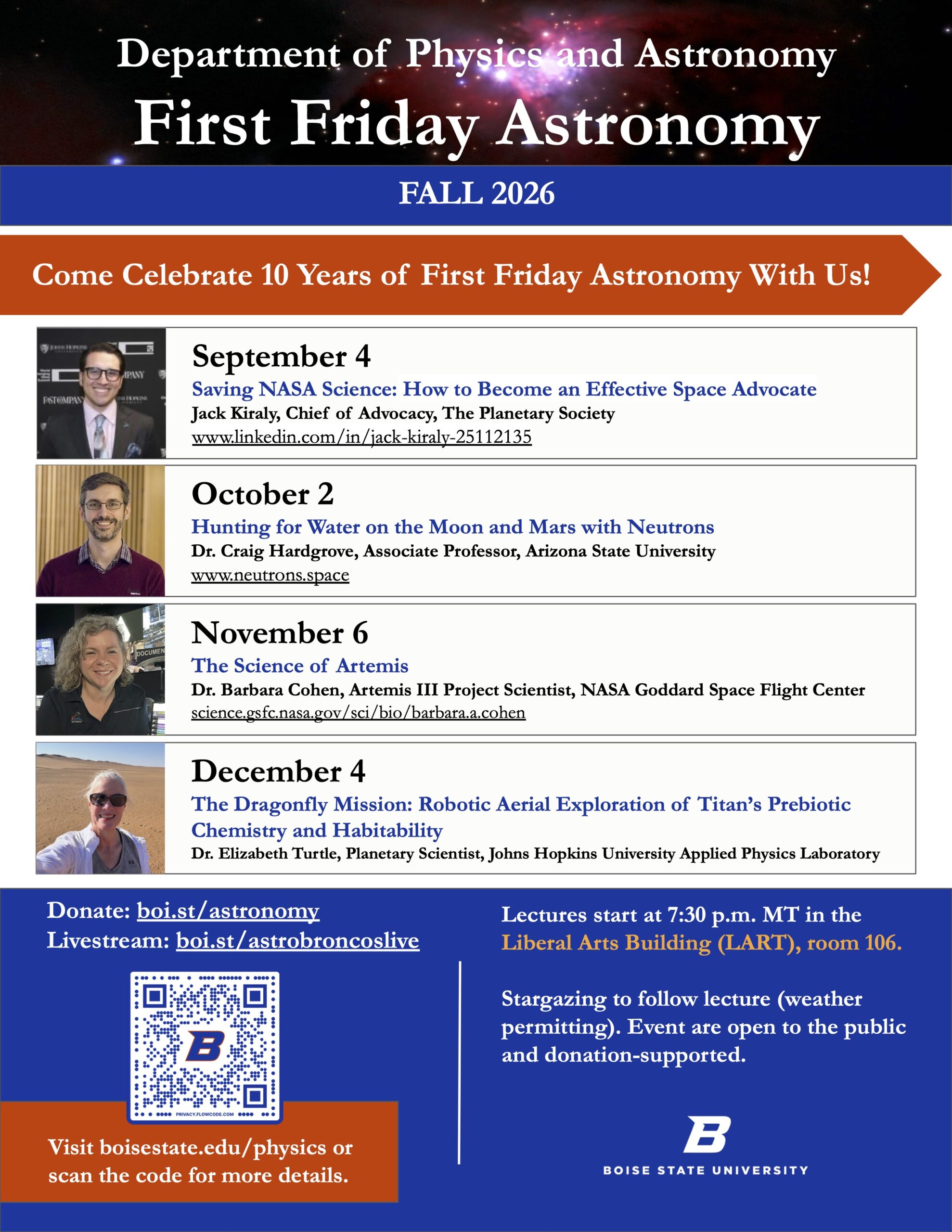
Boise State’s First Friday Astronomy Event Schedule for Summer 2026. Our guests will be
May 1 – Dr. Ellie Hara, Postdoctoral Research Fellow, Rensselaer Polytechnic Institute – From Stardust to Cells: The Unsolved Mystery of Life’s Origin
Jun 5 – Dr. Racine Cleveland, Postdoctoral Research Fellow, Boise State University – Of Dunes and Ice: A Surface-Atmosphere Investigation on Planetary Bodies – racinecleveland.com
Jul 3 – Kirk Long, Ph.D. Candidate, University of Colorado Boulder – How to Weigh a Supermassive Black Hole: Insights From Quasars Across Cosmic Time
Some planets in other solar systems orbit so close to their stars that they are spiral inward, ultimately to be ripped apart and eaten by their stars.
Looking for signs of that in-spiral, many astronomers, including students in my own research group, study transit signals — the shadows of planets as they pass in front of their host stars, as seen from Earth. For a planet spiral into its star, the time between one transit and the next will get shorter and shorter over many years. And so by measuring many transits, we can find signs of tidal in-spiral.
One big problem with looking for such tidally-driven signals is that other effects can also effect the time between transits, and so we need a good way to distinguish between these different effects.
In a recent paper from our group, we map out some ways to tell the difference between these different effects using tides. The bottom line: it’s not easy to tell the difference, but observations of exoplanet transits by citizen scientists can be a really important tool for the long-term monitoring required to find tidally decaying worlds that are not long for this world.
The distribution of orbital eccentricitiese of extrasolar planets with semimajor axes a > 0.2 AU is very uniform, and values for e are relatively large, averaging 0.3 and broadly distributed up to near 1. For a < 0.2 AU, eccentricities are much smaller (most e < 0.2), a characteristic widely attributed to damping by tides after the planets formed and the protoplanetary gas disk dissipated. Most previous estimates of the tidal damping considered the tides raised on the planets, but ignored the tides raised on the stars. Perhaps most important, in many studies the strongly coupled evolution between e and a was ignored. In Jackson+ (2008a), my colleagues and I modeled the coupled tidal evolution of e and a for many extrasolar planets and confirmed that even close-in planets probably began with broadly distributed e-values, like those for planets far from their host stars and unaffected by tides. The accompanying evolution of a-values showed most close-in planets had significantly larger a at the start of tidal migration, and the current small values of a were only reached gradually due to tides over the ages of the planets.
Extrasolar gas giant planets close to their host stars have likely undergone significant tidal evolution since the time of their formation. Tides probably dominated their orbital evolution once the dust and gas cleared away, and as the orbits evolved there was substantial tidal heating within the planets. The tidal heating history of each gas giant may have contributed significantly to the thermal budget governing the planet’s physical properties, including its radius, which in many cases may be measured by observing transit events. Typically, tidal heating increases as a planet moves inward toward its star and then decreases as its orbit circularizes. In Jackson+ (2008b), my colleagues and I computed tidal heating histories for several planets with measured radii. Several planets, including, for example, HD 209458 b, may have undergone substantial tidal heating during the past billion years, perhaps enough to explain its large measured radius. Our models also show that GJ 876 d may have experienced tremendous heating and is probably not a solid, rocky planet.
Tidal heating of Io (left) makes it violently volcanic and unsuitable for life (as we know it). Radiogenic heating of the Earth (center) powers geophysical activity that helps maintain our clement climate. Lack of internal heating and geophysical activity for Mars (right) may have contributed to its present lack of a thick atmosphere, making the planet challenging for life.
Tidal heating of rocky (or terrestrial) extrasolar planets may also span a wide range of values, depending on stellar masses and the planets’ initial orbits. Tidal heating may be sufficiently large (in many cases, in excess of radiogenic heating) and long-lived to drive plate tectonics, similar to the Earth’s, which may enhance the planet’s habitability. In other cases, excessive tidal heating may result in violent volcanism as for Jupiter’s moon Io, probably rendering them unsuitable for life. On water-rich planets, tidal heating may generate subsurface oceans analogous to the ocean in Jupiter’s moon Europa, with similar prospects for habitability. Tidal heating may enhance the outgassing of volatiles, contributing to the formation and replenishment of a planet’s atmosphere. In Jackson+ (2008c), my colleagues and I modeled the tidal heating and evolution of hypothetical extrasolar terrestrial planets to investigate the influence on planetary habitability.
The distribution of the orbits of close-in exoplanets shows evidence for ongoing removal and destruction by tides. Tides raised on a planet’s host star cause the planet’s orbit to decay, even after the orbital eccentricity has dropped to zero. Comparison of the observed orbital distribution and predictions of tidal theory shows good qualitative agreement, suggesting tidal destruction of close-in exoplanets is common. The process can explain the observed cutoff in small orbital semimajor axis values, the clustering of orbital periods near three days, and the relative youth of transiting planets. Contrary to previous considerations, a mechanism to stop the inward migration of close-in planets at their current orbits is not necessarily required. Planets nearing tidal destruction may be found with extremely small semimajor axes, possibly already stripped of any gaseous envelope. The recently discovered CoroT-7 b may be an example of such a planet and will probably be destroyed by tides within the next few Gyrs. Also, where one or more planets have already been accreted, a star may exhibit an unusual composition and/or spin rate.